lean.golf
I’ve had an account on code.golf for years. I’m not very good at it, but every so often I log in and bash my head against the wall trying to improve some horribly convoluted program that, say, prints the lyrics to the 12 Days of Christmas.
In Lean, it’s also often of interest to try to “golf” proofs, cutting them down until they’re as short and direct as possible. Naturally, I thought, “why not make code.golf, but for Lean?”
So, I’ve built lean.golf. Like code.golf, lean.golf hosts a number of holes; each hole gives you a theorem, and your job is to prove it as concisely as you can. There are two modes: classic mode allows essentially any proof method; term mode bans tactic mode entirely (no by). Term mode is much harder and feels more like a type-theory puzzle.
You can play the game here! Sign in with GitHub to save your scores and appear on the leaderboards. Have fun!
(As a disclaimer, I want to differentiate between lean.golf and Lean proof golfing. Proof golfing usually means finding a short proof that is still reasonable—normal whitespace, clear information flow, etc. On lean.golf, the only goal is to write the shortest proof possible, regardless of how ugly it looks. And some of my solutions are quite hideous.)
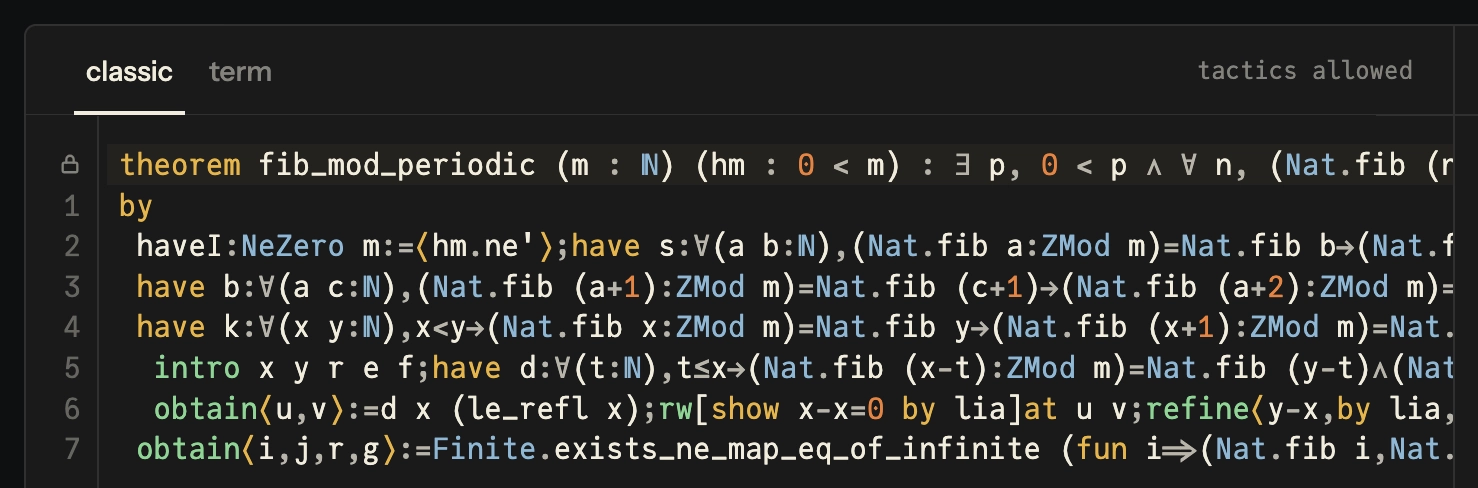
Oh god.
So, the game is really more for fun than practice. Still, I think it gives experienced Lean users a fun excuse to exercise their skills in a different way!
security and deployment
Because lean.golf runs submitted Lean code on my own server, security was the part I was most nervous about. I’m not a security expert in the slightest, but luckily, the engine behind the Lean web playground at live.lean-lang.org is open source! This was a huge help—I was able to reuse lean4web’s Bubblewrap sandboxing to prevent RCE attacks on the server.
This was also my first time self-hosting a web app on a VPS, which was an interesting experience. Somebody really needs to redesign the netcup control panel UI (no offense).
(Update: Thomas Zhu found a vulnerability in the sandboxing mechanism and used it to prove False, as well as run a few commands on the server!! Luckily he told me about the issue before anything was exposed. Very scary though!)
holes
There are 11 holes, which I picked with the help of AI (🙈). Here they are:
hole 1, drinker
theorem drinker (Pub : Type) [Inhabited Pub] (Drinks : Pub → Prop) : ∃ p, Drinks p → ∀ q, Drinks q := sorrySmullyan’s Drinker Paradox: in every nonempty pub, there is someone such that, if they are drinking, everyone is drinking.
proof
By the law of the excluded middle: if everyone is drinking, choose whoever; otherwise, choose someone who is not drinking.
hole 2, spiral
theorem spiral (n : ℕ) : ∑ i ∈ Finset.range (n + 1), Nat.fib i ^ 2 = Nat.fib n * Nat.fib (n + 1) := sorryThe sum of the squared Fibonacci numbers through is . This is the identity behind the Fibonacci spiral. Proof by induction on .
hole 3, no_half_succ
theorem no_half_succ : ¬ ∃ f : ℕ → ℕ, ∀ n, f (f n) = n + 1 := sorryThe successor function on has no functional square root: there is no with .
proof
Suppose . Then , so induction gives . But then , which is impossible for .
hole 4, markov
theorem markov_infinite : ∀ N : ℕ, ∃ x y z : ℕ, 0 < x ∧ x ≤ y ∧ y ≤ z ∧ N < z ∧ x ^ 2 + y ^ 2 + z ^ 2 = 3 * x * y * z := sorryMarkov’s equation, , has infinitely many solutions in . Proof by Vieta jumping: hold two coordinates and flip the third across its quadratic.
hole 5, waerden
theorem waerden9 (c : ℕ → Prop) : ∃ a d, 0 < a ∧ 0 < d ∧ a + 2 * d ≤ 9 ∧ ((c a ∧ c (a + d) ∧ c (a + 2 * d)) ∨ (¬ c a ∧ ¬ c (a + d) ∧ ¬ c (a + 2 * d))) := sorryVan der Waerden’s : no matter how you 2-color the numbers 1 through 9, there is a monochromatic three-term arithmetic progression. Proof by casework.
hole 6, basel_bound
theorem basel_bound (n : ℕ) : ∑ k ∈ Finset.range n, (1 : ℚ) / (k + 1) ^ 2 < 2 := sorryProve that every partial sum of
is less than 2.
commentary
The Basel problem is already in Mathlib, so this hole is more of a rephrasing problem than a proof from scratch. Mathlib’s hasSum_zeta_two is written as follows:
theorem hasSum_zeta_two : HasSum (fun (n : ℕ) => 1 / ↑n ^ 2) (Real.pi ^ 2 / 6)Interestingly, the above takes advantage of Lean’s junk value 1 / 0 = 0, which lets the sum start at index 0. The sum in basel_bound, however, starts at denominator 1. So, some finagling is still necessary even after invoking the value . (A formalization quirk that you don’t see in ordinary mathematics!)
hole 7, binary_multiple
theorem binary_multiple (n : ℕ) (hn : 0 < n) : ∃ m, 0 < m ∧ n ∣ m ∧ ∀ d ∈ Nat.digits 10 m, d ≤ 1 := sorryEvery positive integer divides a decimal number made of only 0s and 1s.
proof
Given , write the numbers for (sorry, (ab)using string power notation here). Mod , these numbers lie in . By the pigeonhole principle, two of them must be congruent mod . Subtract the smaller from the larger to get a positive multiple of whose decimal digits are all 0s and 1s.
hole 8, pisano
theorem fib_mod_periodic (m : ℕ) (hm : 0 < m) : ∃ p, 0 < p ∧ ∀ n, (Nat.fib (n + p) : ZMod m) = Nat.fib n := sorryThe Fibonacci sequence is periodic mod for any (called the Pisano period).
proof
Let and define by . The sequence is eventually periodic because is finite. Since is a bijection, periodicity extends all the way back to the start. (I got this proof from here.)
hole 9, levi
theorem levi_ben_gershon (m n : ℕ) (h : 3 ^ m = 2 ^ n + 1) : m = 1 ∧ n = 1 ∨ m = 2 ∧ n = 3 := sorryIf , then is or . Proof by casework and some modular arithmetic.
hole 10, jacobian
open MvPolynomial in
def JacobianConjecture : Prop :=
  ∀ (n : ℕ) (F : Fin n → MvPolynomial (Fin n) ℚ),
    IsUnit (Matrix.of fun i j => pderiv j (F i)).det →
    ∃ G : Fin n → MvPolynomial (Fin n) ℚ,
      (∀ i, aeval G (F i) = X i) ∧ (∀ i, aeval F (G i) = X i)

theorem jacobian_disproved : ¬ JacobianConjecture := sorry
The Jacobian Conjecture is (famously) false. Proof by counterexample.
hole 11, falso
theorem falso : False := sorryTeehee. Proof by soundness bug.
conclusion
That’s all! I had a lot of fun building lean.golf, and I hope you have just as much fun playing it!